Spring Art Guide New York 2026 What to See Now
by Anni Irish
Spring in New York City is peak time to see art work and be seen. The weather is warmer, people are out, and major shows are opening across the city, which can be overwhelming if you do not know what to see. From galleries to museums, there is a constant flow of exhibitions and projects on view, and there are simply not enough hours in the day to take everything in. There are so many shows and not enough time to view everything, which makes it easy to miss what actually matters. This guide pulls from that density and breaks it down, highlighting a range of exhibitions that feel most significant this spring. It moves between large scale institutional presentations and more focused gallery shows, balancing the major must see exhibitions with others that reward a closer look. Rather than trying to be exhaustive, it offers a way through the noise and a sense of where to spend your time right now.
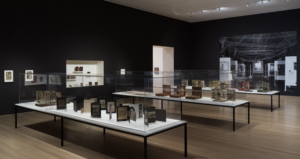
Marcel Duchamp at MoMA April 12 to August 22, 2026
This blockbuster exhibition has been years in the making and is one of the largest shows the museum has mounted in recent memory. It is also the first major retrospective of Duchamp’s work in the United States in over fifty years, making it a rare opportunity to see the full scope of his practice in one place. Co organized with the Philadelphia Museum of Art, the exhibition spans more than six decades and brings together a wide range of works that trace the evolution of his thinking. Often referred to as the grandfather of conceptual art, Duchamp fundamentally changed how art is defined and understood, shifting the focus from object to idea in a way that continues to shape contemporary practice. The show is organized into nine sections and moves from early paintings into the readymades that made him both infamous and foundational. Standout works include all three versions of Nude Descending a Staircase (1913), the notorious Fountain(1917), and L.H.O.O.Q. (1919), his altered Mona Lisa. Even now, the work retains a sense of provocation, particularly in how it continues to challenge ideas of authorship, originality, and taste.
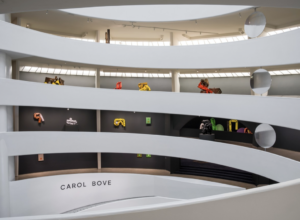
Carol Bove at the Guggenheim March 5 to August 2, 2026
This retrospective traces more than twenty five years of Carol Bove’s practice and marks her first major survey at the Guggenheim. The exhibition brings together a wide range of work, from large scale sculptural pieces and assemblages to smaller, more intimate works on paper and drawings, offering a sense of the full trajectory of her career. Bove has long been interested in how viewers perceive and interact with sculpture, and in this exhibition she takes into account the Guggenheim’s Frank Lloyd Wright designed architecture, using it as both a constraint and a framework. Installed in reverse chronology, the show encourages viewers to move through the space in a way that foregrounds shifts in perception and meaning over time. With over one hundred works on view, including Alicia, a site specific ceramic mural by Joan Miró and Josep Llorens Artigas that remained hidden behind gallery walls for more than twenty three years, the exhibition highlights the artist’s ongoing engagement with material, fragmentation, and the instability of form.
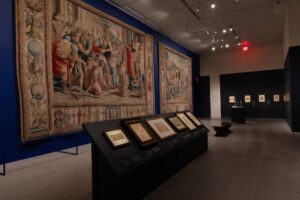
Raphael: Sublime Poetry at The Met April 12 to June 28, 2026
One of the most talked about exhibitions this season, this show revisits Raphael not only as a central figure of the Renaissance, but as an artist shaped by ambition, competition, and patronage. Working at the same time as Michelangelo, Raphael became one of the most sought after painters of his era, completing major commissions for the Vatican at a young age. Their rivalry, particularly during the 1510s, has become a defining narrative within art history, shaping how both artists are understood. The exhibition features more than 170 works and traces the full arc of Raphael’s career, from early paintings to later, more complex compositions. It emphasizes both his technical precision and his ability to construct highly idealized imagery, offering insight into how carefully calibrated beauty functioned during this period. At the same time, the show underscores the broader systems of power and visibility that shaped his success, situating his work within a larger cultural and historical context.
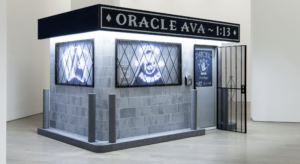
Nick Doyle at Perrotin April 24 to May 30, 2026
In his latest solo exhibition, Collective Hallucination, Nick Doyle expands his practice into a more overtly technological and psychological register, engaging with themes of artificial intelligence, belief systems, and the mythology of progress. The exhibition includes a series of wall mounted works alongside a central installation that pushes his work into a more immersive direction. A focal point of the show is Mirror Mirror, an installation designed to resemble storefront psychic spaces often found in strip malls and urban settings. On the exterior, a sign advertises low cost readings, while inside viewers encounter Ava, an AI avatar rendered in the style of a generic Valley girl who interacts with visitors in real time. The work is both humorous and unsettling, creating a space where performance, technology, and projection intersect. In some ways, this marks a departure from Doyle’s earlier work, which often emphasized handcrafted elements, but it also extends his ongoing interest in how meaning is constructed, mediated, and consumed.
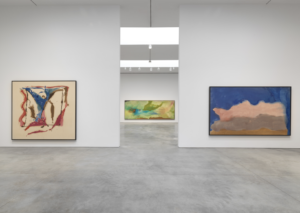
Helen Frankenthaler at Gagosian Through July 2, 2026
The Moment and the Distance brings together more than twenty works by Helen Frankenthaler spanning four decades, from 1960 to 1992, offering a focused view of her evolving approach to painting. Early works foreground her soak stain technique, in which diluted pigment is absorbed directly into raw canvas, creating a sense of immediacy and fluidity. Later works expand into broader, more structured compositions, while still maintaining a sense of openness and movement. Paintings such as Provincetown I (1961) highlight the directness of her early approach, while works like Ocean Drive West #1 (1974) demonstrates a shift toward larger, more defined color fields. Other works, including Mornings (1971) and Thanksgiving (1972), balance loose, gestural elements with more controlled compositional structures. Across the exhibition, there is a consistent tension between spontaneity and control, with later paintings continuing to build a layered sense of atmosphere and depth.
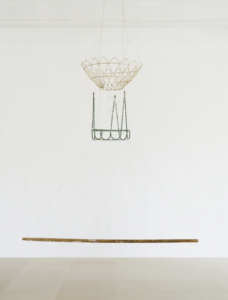
Gedi Sibony at Greene Naftali Through June 20, 2026
At Greene Naftali, Gedi Sibony’s The Invisible Point continues his use of remnant and discarded materials to produce understated, tightly composed sculptures. Several works are built from stacked sections of salvaged bookshelves, their modular forms slightly misaligned in ways that emphasize both structure and fragility. The materials remain legible, but their arrangement shifts them into something more provisional and considered. A new group of paintings extends this approach into a quieter register, composed of sparse marks that activate otherwise empty surfaces. Rather than directing attention to a single focal point, these works emphasize spacing, edges, and subtle shifts in perception. Across both sculpture and painting, Sibony maintains a consistent tension between presence and absence, asking the viewer to slow down and register small changes rather than overt gestures.