
Good morning. I’m writing to you from the international terminal in Mexico City, still buzzing after a week of nonstop art-fair immersion. Forgive me if this entry feels slightly rambling, I’m still metabolizing what was, in every sense, a spectacular week.
Zona MACO 2026, the anchor of Mexico City Art Week, drew tens of thousands of collectors, curators, and art-world professionals from across the Americas and Europe. The broader week unfolded across more than 25 exhibitions and upwards of 70 events citywide. The fair itself featured roughly 228 galleries from around 26 countries, spanning contemporary art, modern, design, photography, books, and historical material. By any metric, the scale was immense.
And yet, the most surprising part of the week wasn’t Zona MACO itself.
It was the satellite fairs, Material and Salón ACME, which, in very different ways, assembled some of the most compelling, experimental, and genuinely curious work I’ve encountered in quite some time. That contrast felt significant, and it’s something I’ll continue to unpack.
Over the coming weeks, I’ll be sharing additional selections from Zona MACO, along with deeper write-ups on the satellite fairs and off-floor conversations that shaped the week. (Those will land first via our Salon)
2025 < 2026
Last spring, in What Defines Power Now, I argued that power was shifting away from visibility and toward control, away from loud platforms and toward trusted intermediaries, private networks, and embedded relationships. That wasn’t a stylistic prediction; it was a structural one, drawn from patterns already visible in my work.
By 2025, visibility had stopped functioning as power. The fractures were already present: reach without leverage, inclusion without conversion, momentum without durability. The system hadn’t collapsed, but it had begun to fail quietly particularly at the middle.
Zona MACO 2026 showed what that shift looks like in practice. Attendance was strong, but conversion in the mid-market lagged. Confidence concentrated at the top end, while a significant share of meaningful transactions occurred off-floor, through studios, private conversations, and existing relationships. In parallel, developments in the Gulf showed capital responding to the same conditions by reducing visibility pressure altogether in favor of inducement and long-term alignment.
These are not isolated signals. They are the observable effects of a power shift already underway.
The Fair as confirmation, no longer discovery
Zona MACO is vast and opulent, and this year the fair felt careful, measured, polished, and restrained. That posture was reinforced by a conspicuous lack of information on the floor. What would be standard at nearly any other international fair, labels, artist names, even price lists, was often absent. Visitors were frequently overheard asking one another, “Do you know this?” while trying to locate exhibitors or contextualize the work.
I was mistaken more than once for a dealer showing at the fair, which, while briefly flattering, was also quietly concerning.
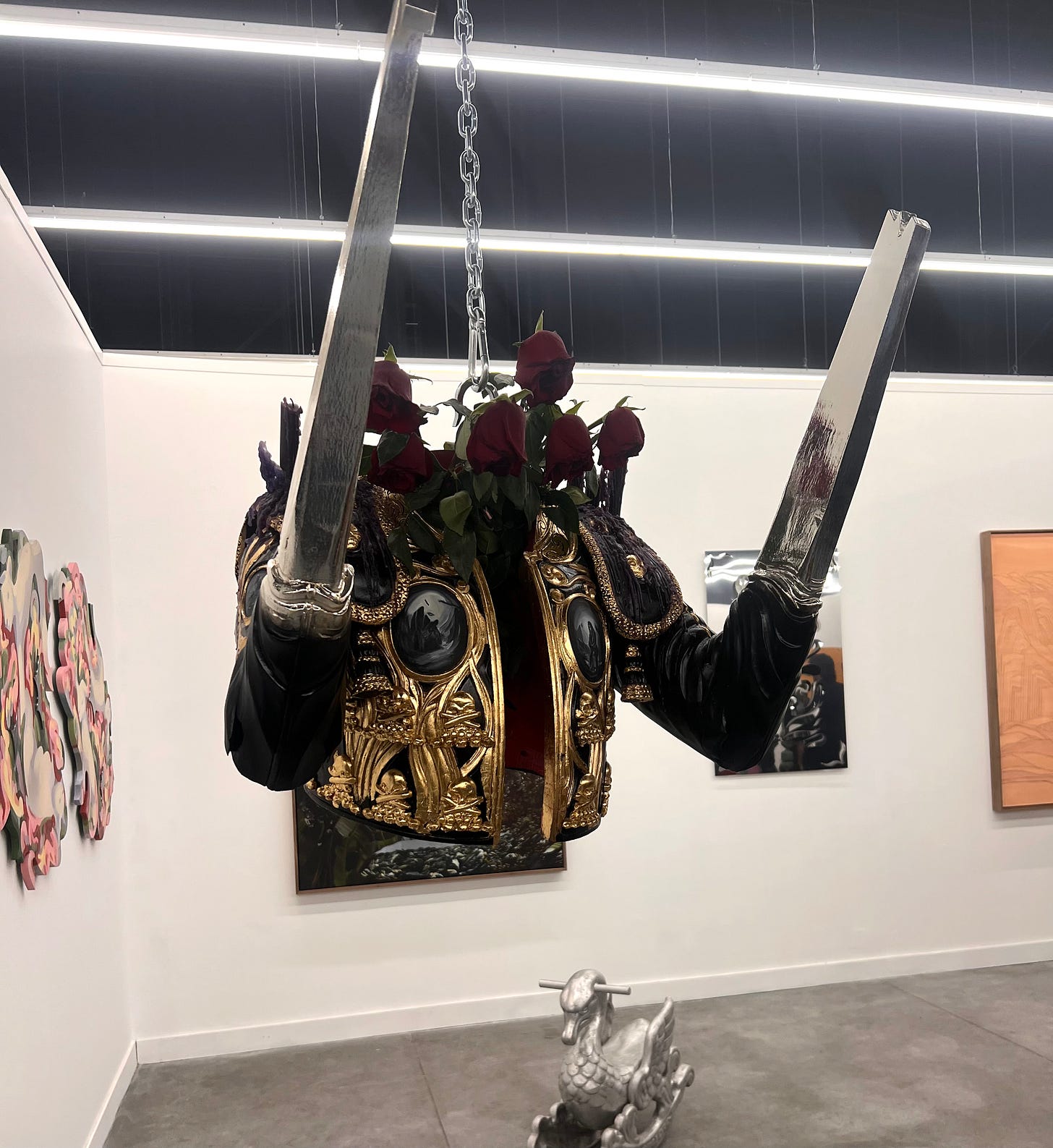
Terminator matador at Material Art Fair
Material, by contrast, felt scrappy and alive. Booths embraced risk, humor, and contradiction, presenting work that was unapologetically avant-garde, conceptual, and at times mischievous. Salón ACME unfolded with a quieter confidence: immaculately curated rooms exploring labor, historical activism in Mexico, and the politics of the night, culminating around a suspended clown sculpture floating at the center of a bohemian Mexican palazzo hovering somewhere between celebration and unease.
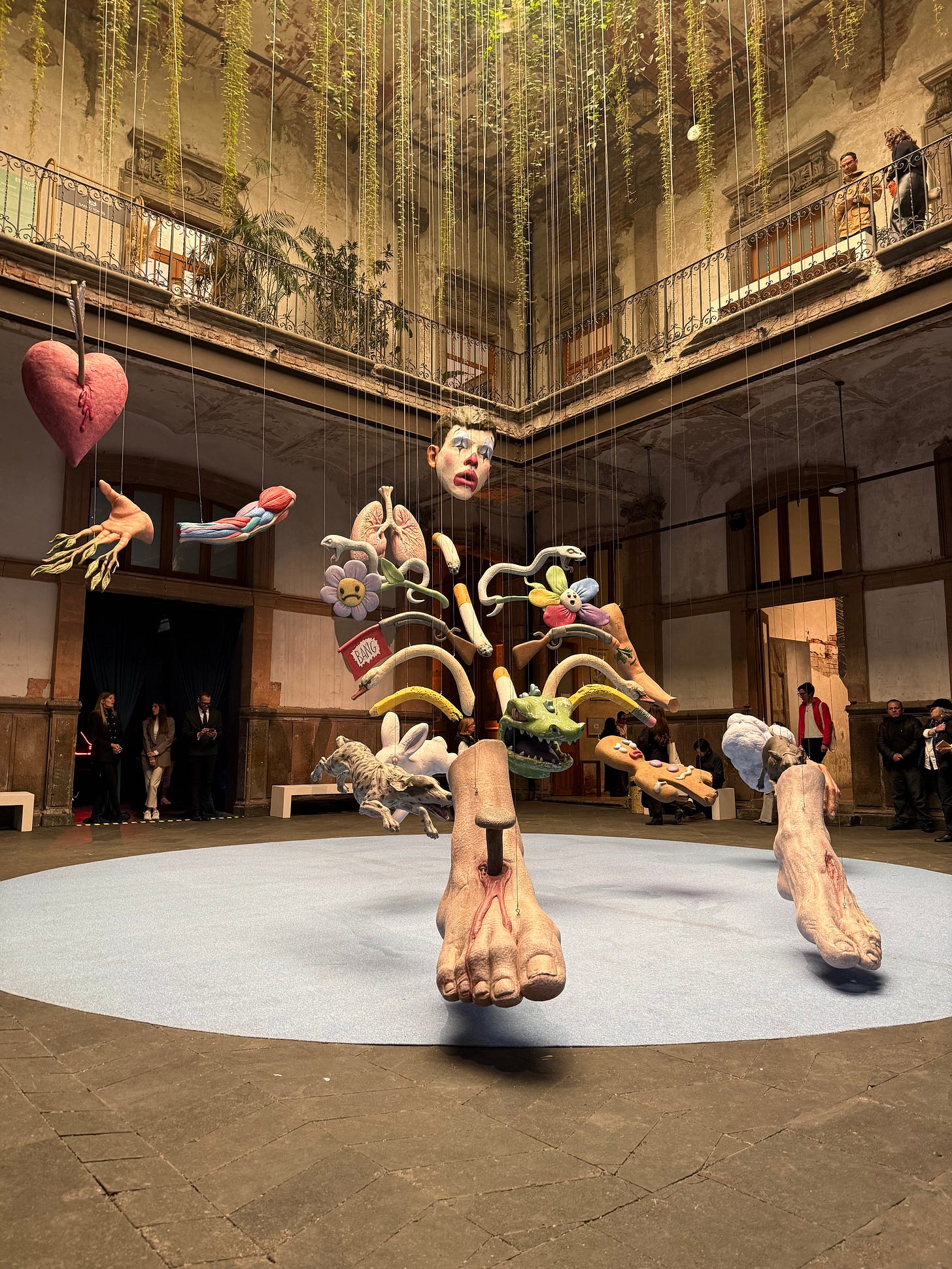
Enrique López Llamas I Am The Resurrection and I Am The Life at Salón ACME
The contrast was striking.
Where Zona MACO reflected the current center of the market, the satellite fairs gestured toward its edges, where ideas are still forming, risk hasn’t yet been sanded down, and work reads less like inventory and more like proposition.
What was actually selling
Crowds were strong and the atmosphere celebratory across all fairs, but sales on MACO’s fair floor were uneven. By Sunday, there were remarkably few visible red dots, and despite sustained foot traffic, the pace on the floor felt subdued. The satellite fairs told a different story: buyers, artists, and collectors were in high spirits, with several booths selling out from tightly edited presentations of four to six works, and notable institutional presence circulating off-floor.
Public inventory on Artsy mirrors what was felt in person. The largest concentration of works by volume sat in the low five-figure to low six-figure range, works on paper, small to mid-scale paintings, sculpture, and editions historically priced between roughly $5,000 and $150,000. Six- and seven-figure works were present, but in far smaller numbers and largely concentrated among a narrow group of blue-chip galleries.
This matters because the $5,000–$150,000 band is what traditionally sustains the fair ecosystem.
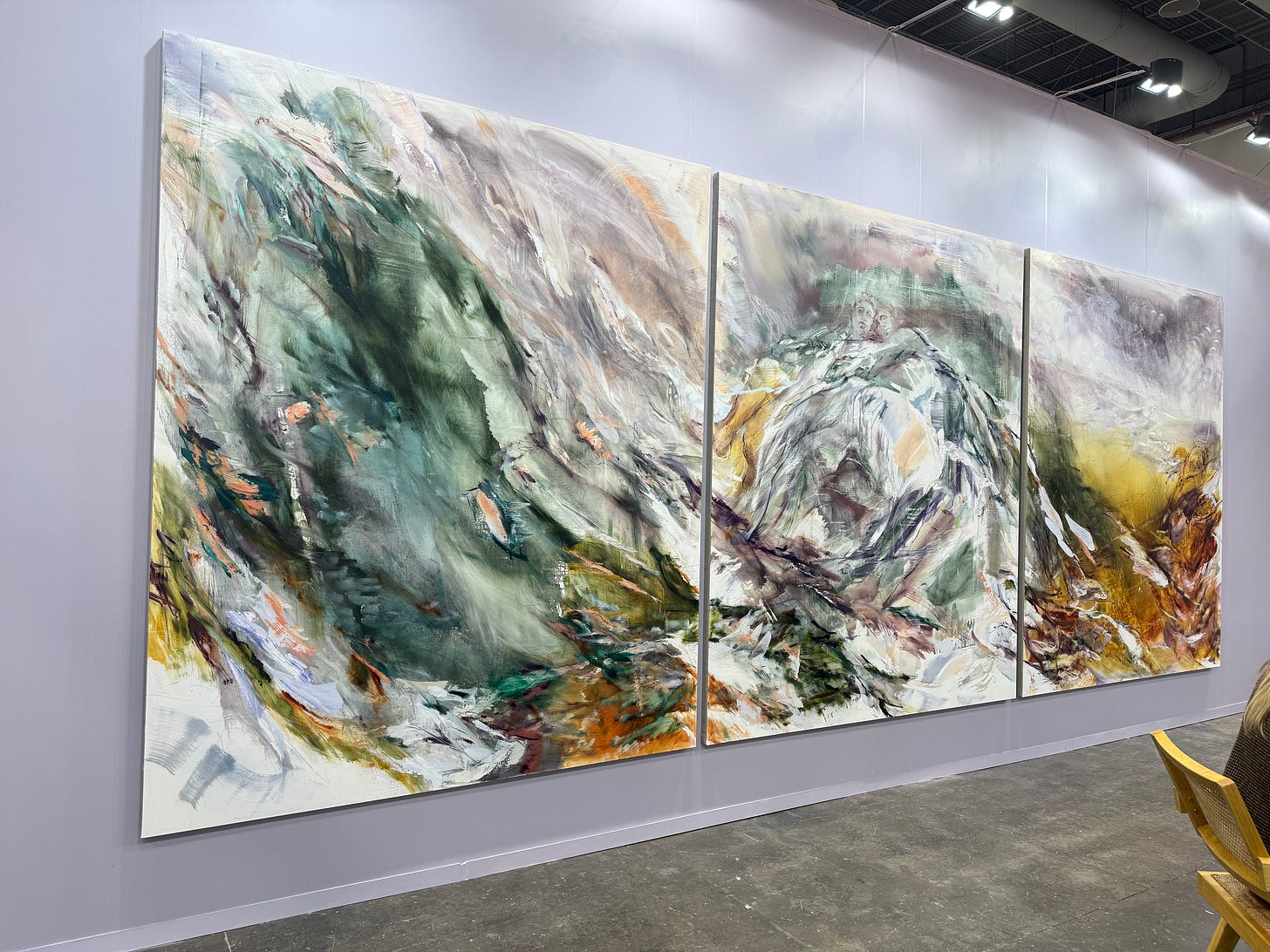
Pace Gallery’s solo booth with paintings by Kylie Manning functioned as a study in certainty. Monumental, resolved, and unapologetically safe, the presentation made clear that at the top end of the market, power no longer comes from visibility or risk, but from position, scale, and institutional calm.
While the work is accomplished, the choice was unsurprising. The booth left little room for friction or discovery, reading less as a proposition than as a declaration, another instance of a mega-gallery deploying large-scale expressionist painting not to test ideas, but to signal stability. For me, it offered little beyond confirmation of the argument already in motion. For the record I like Kylie Manning, these just felt a little to safe for me.
Outside of a small number of blue-chip booths, conversion and energy on the floor was cautious. Meanwhile, multiple artists and dealers reported selling out through studio visits and off-floor conversations during the same week, entirely outside the fair’s transactional structure.
At a fair of MACO’s scale and significance, that divergence, between visible attendance and where transactions actually occurred, is not incidental. It is a bright and blinding sign.
The Gulf contrast: containment through inducement
Running parallel to Mexico City Art Week was the debut of Art Basel Qatar 2026, positioned less as a market engine and more as a long-game intervention. With a smaller gallery count, heavy institutional backing, and participation incentives, subsidized costs, access promises, long-term relationship narratives, the fair acknowledged something Western fairs are increasingly confronting: visibility alone no longer reliably converts into value.
What was equally telling was the visual narrative. Public imagery skewed glossy and celebrity-adjacent, emphasizing proximity to power and luxury over experimentation or curatorial tension. The work itself, while often technically accomplished, rarely felt speculative or unresolved. It appeared finished, legible, and culturally pre-approved. The prevalence of gold was hard to miss, at once ironic and entirely symbolic of the moment.
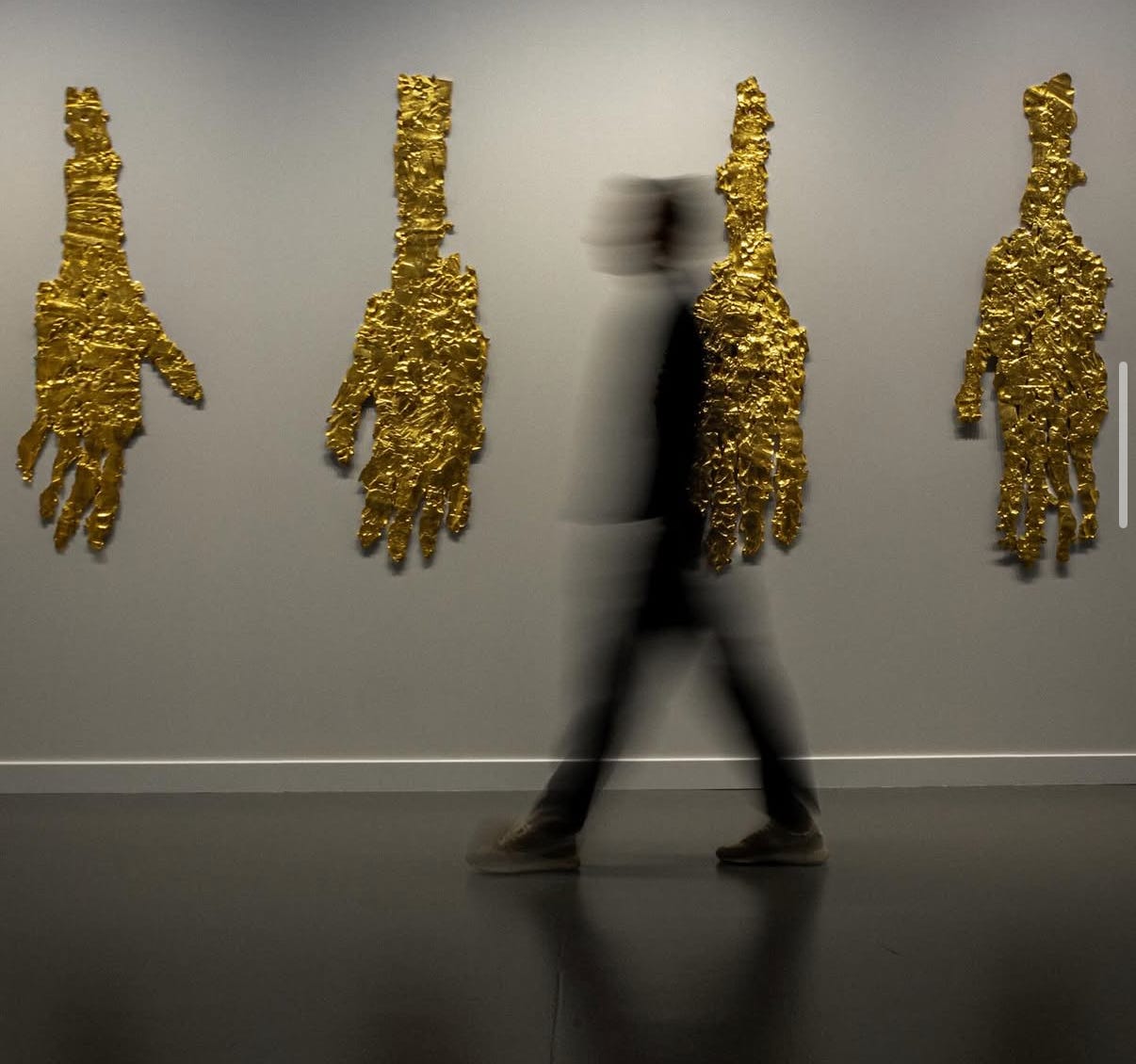
Georg Baselitz, Darkness Goldness. Gold, scale, and repetition deployed without apology. A reminder that at the top end of the market, authority doesn’t seek attention it assumes it.
It’s also worth noting where blue-chip attention consolidated. Nearly every major global gallery prioritized Qatar that week, while Pace stood largely alone at Zona MACO. That contrast felt less like coincidence than strategy: different stages, different signals, different kinds of certainty being performed for different audiences.
This isn’t a critique of seriousness; it’s an observation of strategy. Placed next to Mexico, the contrast is instructive. One model builds gravity through incentives and polish. The other negotiates meaning through friction, labor, and informal networks. Both are responding to the same structural reality. They are simply choosing different strategies for what comes next.
Artist selections where attention held (for me)
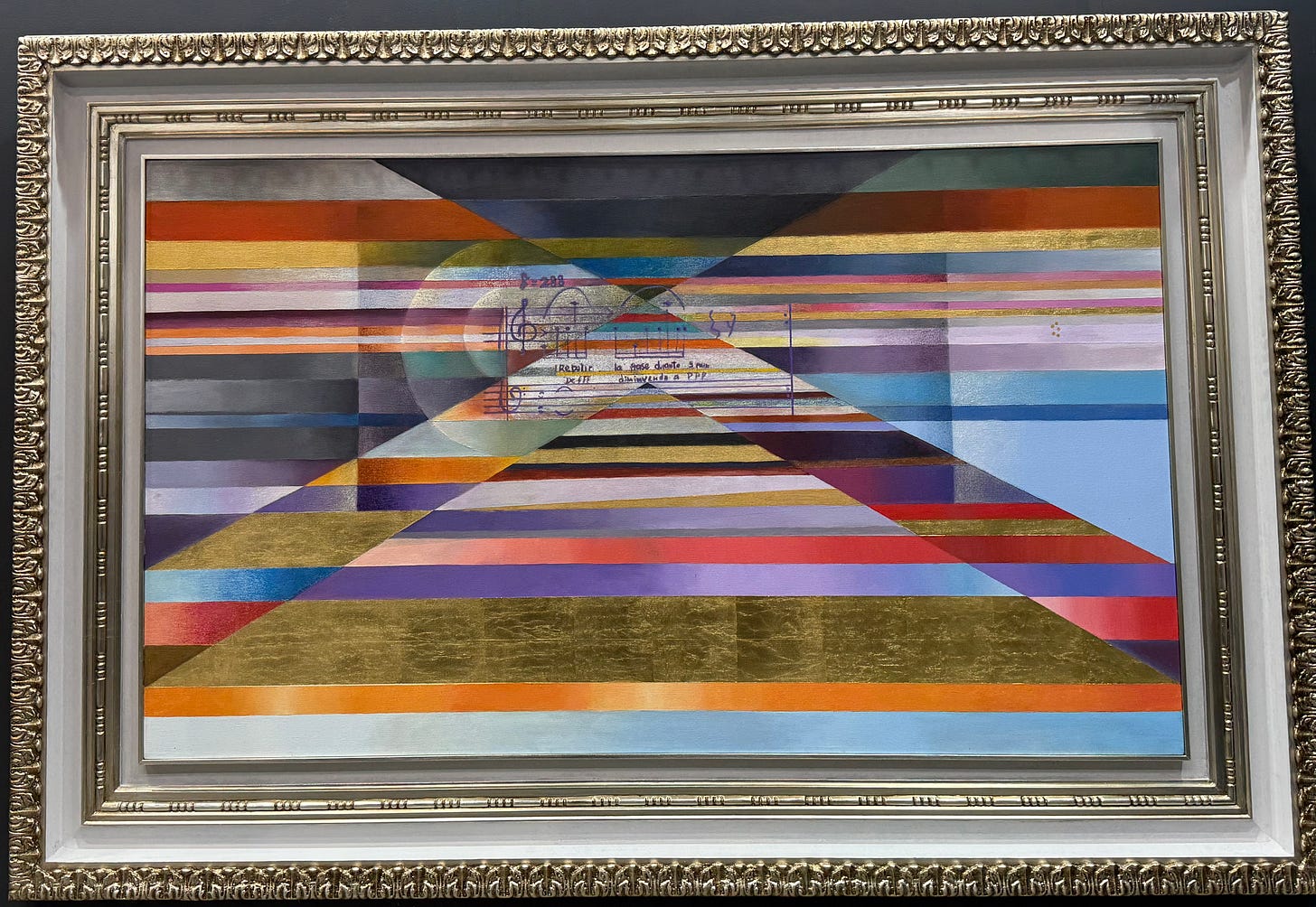
Arnaldo Coen, presented by Galería Duque Arango.
Shown without title, price, or wall text and hung crooked, in a twenty-thousand-dollar frame, this work operated from a position of assumed authority, echoing the many Botero presences scattered throughout the fair. Geometry, gold leaf, and tightly controlled color bands form an image that functions less as a painting than as a system, my favorite work from this artist I have ever seen.
In a fair where much of the mid-market struggled to convert attention into sales, this piece existed in a different economy altogether, one aligned with the blue-chip logic visible both at MACO and in Qatar. Governed by legacy, institutional trust, and long-term positioning rather than visibility, it was my favorite of the “assured” selections on view and a standout choice for collectors seeking certainty without spectacle. A beautiful and quietly powerful piece.
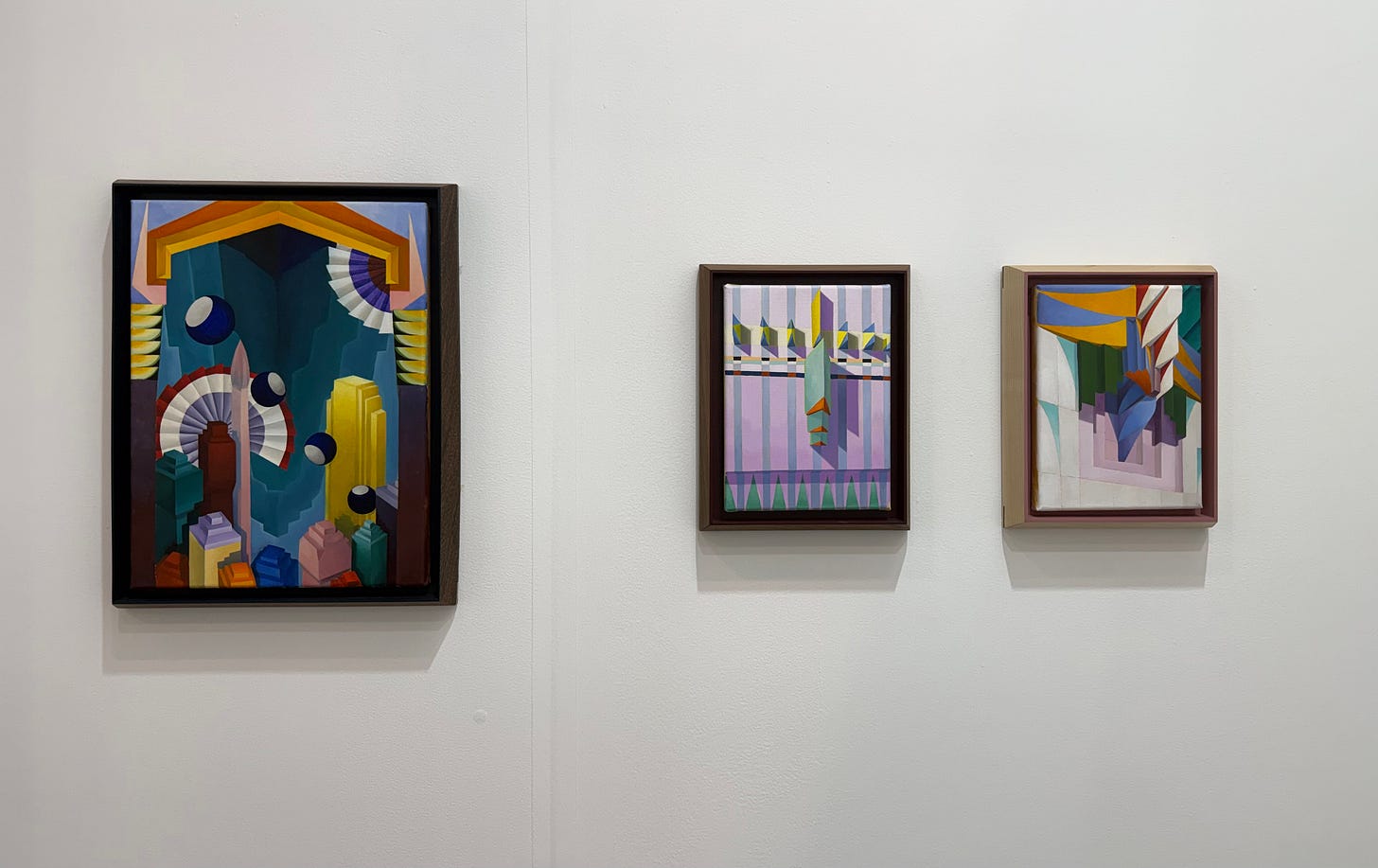
Matthias Schaarreman Presented by Brandt Gallery
Matthias Schaarreman’s paintings were among the most surprising encounters of the fair. Playful yet disciplined, the works operate like compressed architectural studies built from geometry, color planes, and illusionistic depth. They reference early modernist abstraction and stage design without slipping into nostalgia, maintaining a lightness that feels intentional rather than casual.
Priced accessibly, the work sat squarely in the fair’s most important band and actually delivered: resolved, thoughtful, and genuinely enjoyable to live with. In a market where so much mid-scale work felt overdetermined or strained, Schaarreman’s paintings stood out for their confidence without heaviness proof that seriousness and pleasure don’t have to be opposites.
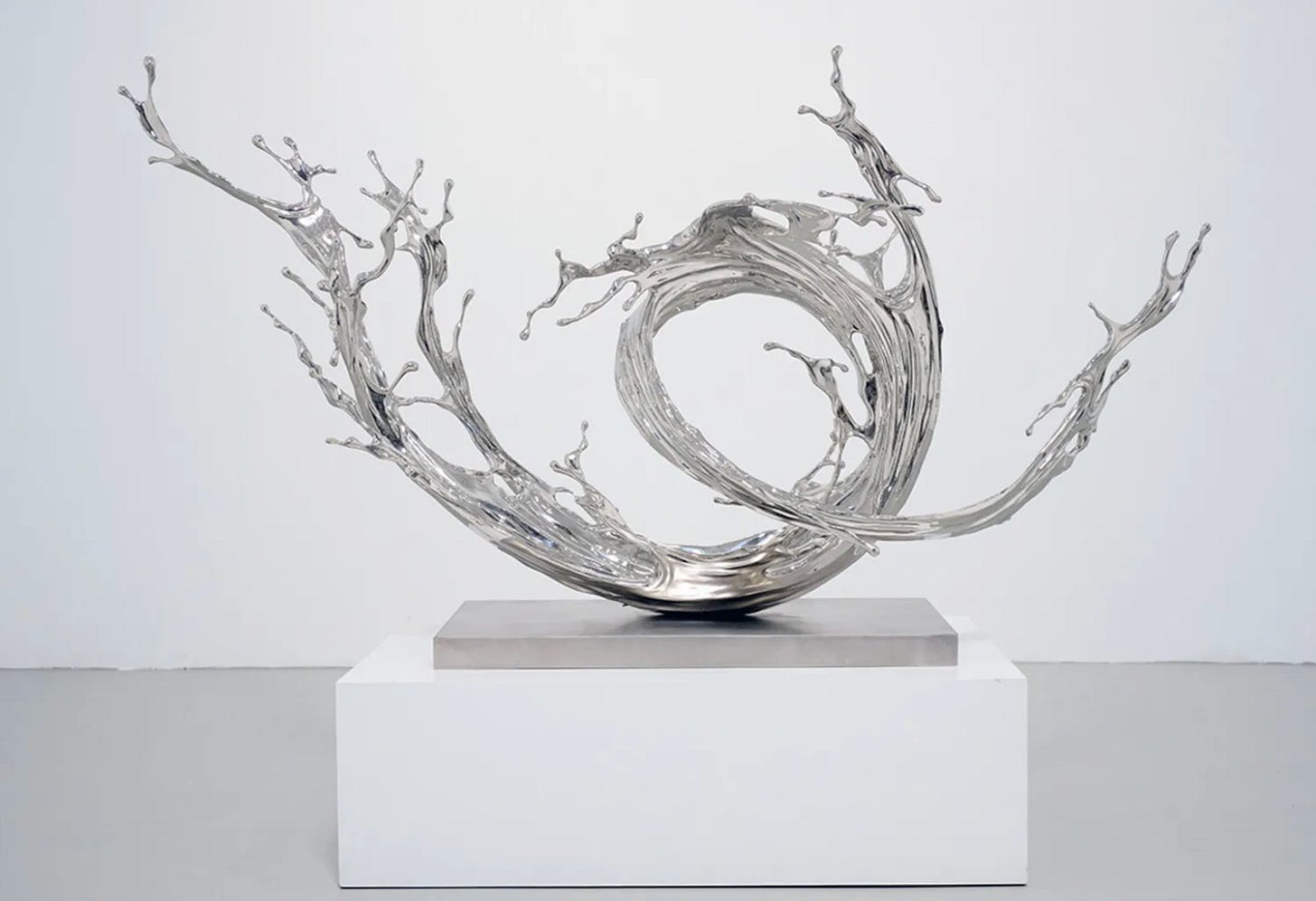
Zheng Lu Presented by Sundaram Tagore Gallery
Zheng Lu’s stainless-steel sculpture drew me in for a simple reason: I’m a sucker for water (its my element and astrological sign) and this freezes it at its most expressive. Part of his Water in Dripping series, the work translates the fluidity of calligraphy and natural movement into a rigorously engineered form. It’s technically virtuosic without being loud, expressive without theatrics. In a week where much mid-market work struggled to convert attention into confidence, this piece operated with quiet assurance proof that mastery, material ambition, and restraint still command gravity on the fair floor.
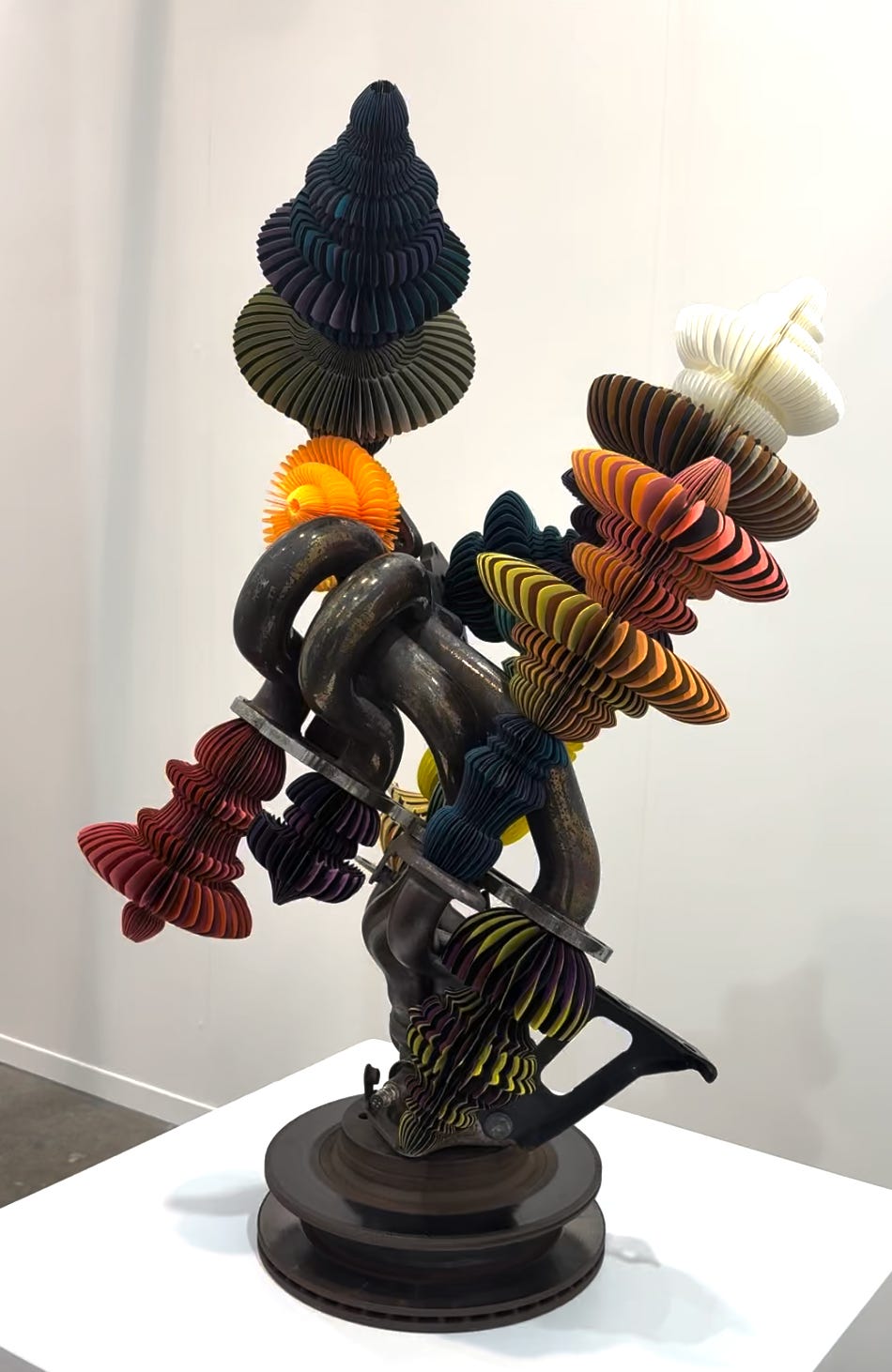
Keita Miyazaki’s work stood out not through spectacle, but through precision (and one of my current favorites) Composed of meticulously fabricated, fan-like elements radiating from an exposed armature, the sculpture balanced exuberant color with visible structure, growth held in check by engineering. It was neither decorative nor monumental; instead, it accumulated authority through repetition, rhythm, and restraint. The piece asked to be read slowly, as a system rather than an image, rewarding attention rather than demanding it.
Its significance at Zona MACO went beyond formal strength. Miyazaki’s presence felt emblematic of a broader, increasingly visible Asian influence in Mexico’s contemporary art ecosystem an influence evident not only in gallery programs, but across the city itself, from studios to restaurants to cultural spaces shaped by a growing Korean and East Asian diaspora. This wasn’t fusion as novelty; it was coexistence as fact. Miyazaki’s work embodied that reality: materially rigorous, culturally fluent, and fully at ease outside the need for explanation. In a week defined by questions of power and position, it signaled a future that is less about center and periphery and more about who is building quietly, with intention, across borders.
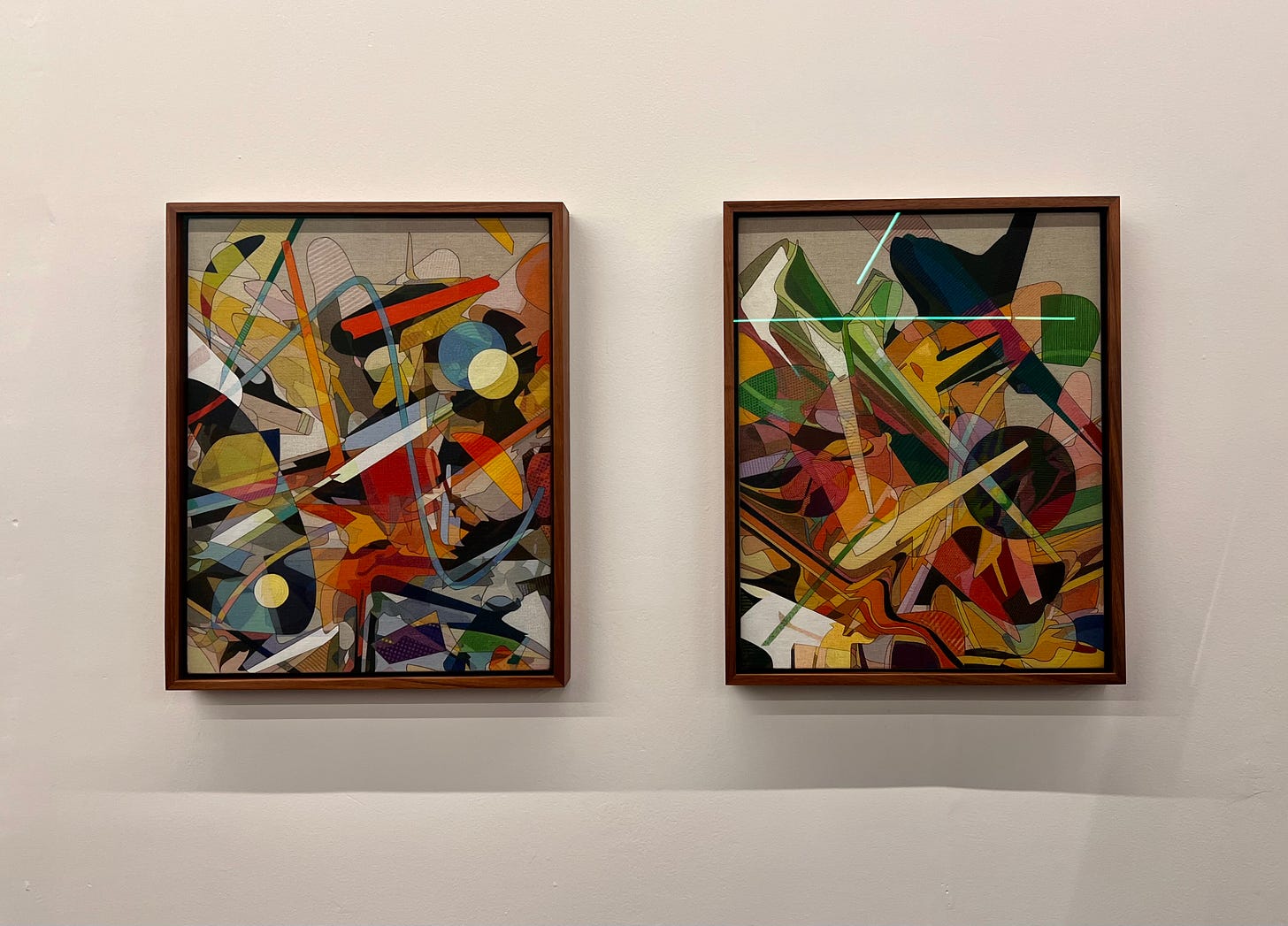
Omar Rodriguez-Graham at material by Galleria Macca. My first time seeing smaller works from this artist, of course sold instantly much to my disappointment.
What ties these selections together isn’t taste so much as signal. Across these artists, the work that held attention asked for sustained looking rather than immediate reaction. These were not pieces designed to dominate a booth or win the Instagram sweepstakes. They operated through material intelligence, repetition, and restraint, systems built deliberately, with enough internal coherence to stand without explanation.
This runs counter to how fairs are often framed: as engines of spectacle, speed, and instant validation. What Zona MACO revealed, once you looked beyond the loudest booths, was a widening divide between what draws crowds and what sustains meaning over time.
Taken together, the data and on-the-ground behavior point to a structural shift rather than a change in taste.
At Zona MACO, the majority of listed inventory by volume sat in the $5,000–$150,000 range, the band that has historically sustained fair participation. Yet this same segment showed the weakest visible conversion on the floor. Attendance was strong, but transactions were uneven. At the same time, artists and galleries reported stronger outcomes through studio visits, private conversations, and off-floor contexts during the same week.
At the top end, the picture was markedly different. Six- and seven-figure works, largely concentrated among a small group of blue-chip galleries, were fewer in number, often shown without visible pricing or wall text, and positioned with confidence rather than urgency. These works were not competing for attention; they were operating within an economy governed by institutional trust, placement history, and long-term relationships.
This stratification is mirrored in public inventory on Artsy. Listings skew toward materially specific, small to mid-scale works with clear pricing, while the highest-value pieces are selectively withheld from open pricing or not listed at all. Transparency does the work at the lower end of the market; opacity signals confidence at the top.
Viewed alongside developments in the Gulf, where fairs are reducing participation friction through subsidies, access incentives, and long-term alignment, the pattern becomes clearer. Different regions are responding to the same structural reality: visibility alone no longer reliably converts into value. Western fairs absorb that pressure through increasing strain on the mid-market; Gulf institutions absorb it by shifting costs and courting alignment in advance.
What’s emerging is not a collapse of the fair model, but a redefinition of its function. Increasingly, fairs operate as validation platforms rather than primary sales engines, particularly for mid-market work. They confirm positioning and relationships more than they generate first-time demand. The work that circulates most effectively now is work that can move between contexts, fair booth, studio, private viewing, without losing coherence or requiring explanation.
Why this matters for artists and collectors
For artists:
The takeaway is operational, not philosophical. Practices that depend on constant activation, new narratives, frequent repositioning, visibility-driven momentum through Instagram, exhibitions, or timed drops, are more exposed now than they were even a year ago. What’s holding up best is work that is structurally legible, materially disciplined, and capable of sustaining interest outside high-pressure, high-visibility environments. If the work needs continuous explanation or novelty to remain relevant, the system around it is increasingly fragile.
For collectors:
The advantage has shifted from speed to judgment. As price bands compress and attention becomes a weaker predictor of value, the strongest positions come from sustained engagement rather than quick decisions. Studio visits, long conversations, and slower timelines are no longer conservative strategies, they’re increasingly the most informed ones. The work that endures is work that continues to reward looking after the fair, after the post, after the moment passes.
Seen this way, the throughline from spring 2025 to now is not a reversal, but a clarification. Last year exposed the limits of visibility as a proxy for power. This year shows how the market is reorganizing around that fact, unevenly, regionally, and with real consequences for how art is made, shown, and collected.
Thank you for reading. If you’re interested in seeing more of the work encountered at Zona MACO, along with deeper write-ups from the satellite fairs and the off-floor conversations that shaped the week, that material will be shared through our Salon.
We’ve built this space as a salon in the traditional sense: a private, ongoing conversation among artists, collectors, and cultural operators who value context and connection. As was tradition in the arts long ago is becoming relevant once again: Some things unfold publicly. Increasingly, the meaningful ones happen quietly and privately.
Hope to see you and warmest regards,
Rachael