The 82nd edition. 56 artists, duos, and collectives, co-organized by curators Marcela Guerrero and Drew Sawyer. Whitney Museum of American Art Running March 8 through August 23.
Every Whitney Biennial arrives with the expectation that it will take the cultural temperature of the moment. The 2026 edition, opening to the public on March 8, does reflect the current climate in one important way. It is remarkably careful.
Curated by Marcela Guerrero and Drew Sawyer, the exhibition brings together 56 artists spread across the museum’s fifth and sixth floors. Compared with some of the sprawling biennials of the past decade, the scale of this year’s exhibition is noticeably restrained. The curators frame the show through language that emphasizes interconnected systems and relationships, describing the exhibition through ideas of networks, infrastructures, and forms of relationality that link people, technologies, ecologies, and histories.
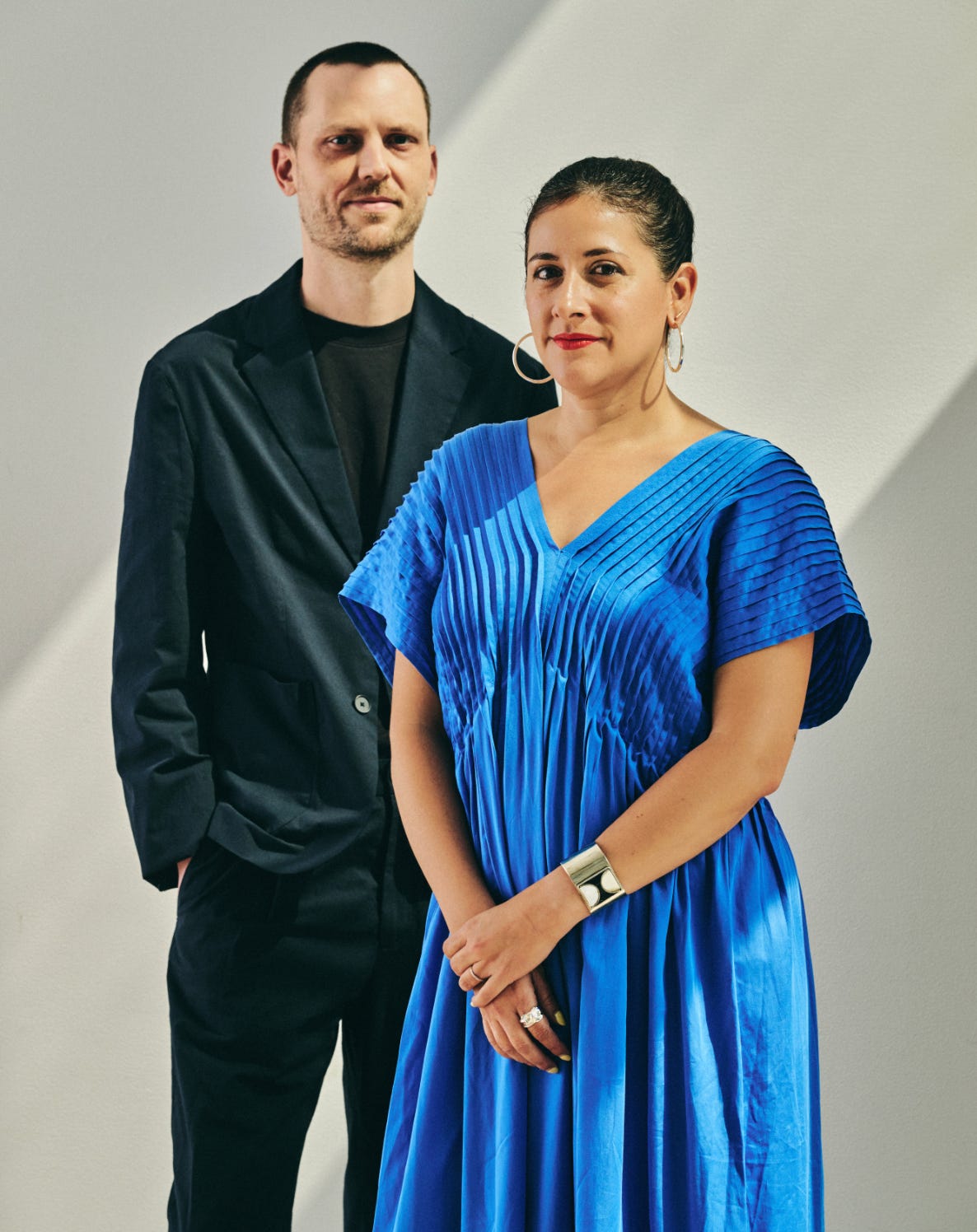
Curators Marcela Guerrero and Drew Sawyer
Those terms promise a broad conceptual framework capable of holding the complexity of the present moment. In practice, however, the exhibition often feels as if it is avoiding a clear position. The works touch on themes that feel unavoidable in contemporary discourse, including colonial histories, ecological precarity, identity politics, and shifting power structures. Yet the exhibition rarely organizes these concerns into a direct argument. Instead they appear scattered across the galleries, referenced but rarely pushed into sharper focus.
Moving through the show produces the feeling that the biennial is circling its subject rather than confronting it. At the press preview the atmosphere in the galleries reflected that ambiguity. Critics and curators drifted between rooms trying to determine whether the exhibition’s diffuse structure was intentional or simply unfocused. Conversations repeatedly returned to the same uncertainty about what exactly the biennial was attempting to say. The show contains work that gestures toward urgent political questions, but it rarely allows those tensions to accumulate into anything that resembles a central thesis.
This reluctance may have less to do with the individual artists than with the institutional environment museums now occupy. Cultural institutions have spent the past decade navigating increasing scrutiny from donors, activists, and political actors. The idea of the museum as a space that can freely stage political confrontation has become more complicated as the governance structures behind those institutions have become more visible. The Whitney has experienced these pressures firsthand and remains closely associated with one of the most visible museum controversies of the past decade.
In 2019 the institution became the site of sustained protests surrounding board member Warren Kanders, whose company Safariland manufactured tear gas used against migrants at the United States–Mexico border and against protesters internationally. Demonstrations inside the museum lasted for months and eventually prompted several artists participating in that year’s Whitney Biennial to withdraw their work. The pressure ultimately forced Kanders to resign from the board, but the episode revealed how intensely museum governance and cultural politics had become intertwined.
More recently the museum has also faced criticism surrounding the restructuring and temporary suspension of its long-running Independent Study Program. For decades the program functioned as one of the most politically engaged educational environments for artists, critics, and curators in the United States. Changes to the program raised questions about whether the institution was recalibrating how openly political its educational and curatorial initiatives might be.
Seen within that history, the cautious tone of the 2026 biennial begins to look less accidental. The exhibition does not avoid political subject matter, but it distributes those concerns across such a wide conceptual terrain that they rarely consolidate into a clear statement. The result is a show that acknowledges the presence of political tension without fully inhabiting it. Rather than pushing viewers toward confrontation or clarity, the exhibition disperses its themes into a field of references that feel intentionally noncommittal.
That evasiveness becomes particularly visible in contrast to works that attempt to sharpen their critique. One of the most compelling examples appears in a video installation by the film collective kekahi wahi, founded by filmmaker Drew K. Broderick and Santiago Miata Shiba Nash. The artists focus on Hawai‘i and the cultural imagery that surrounds it, examining how contemporary media aesthetics intersect with the longer colonial history of the islands.
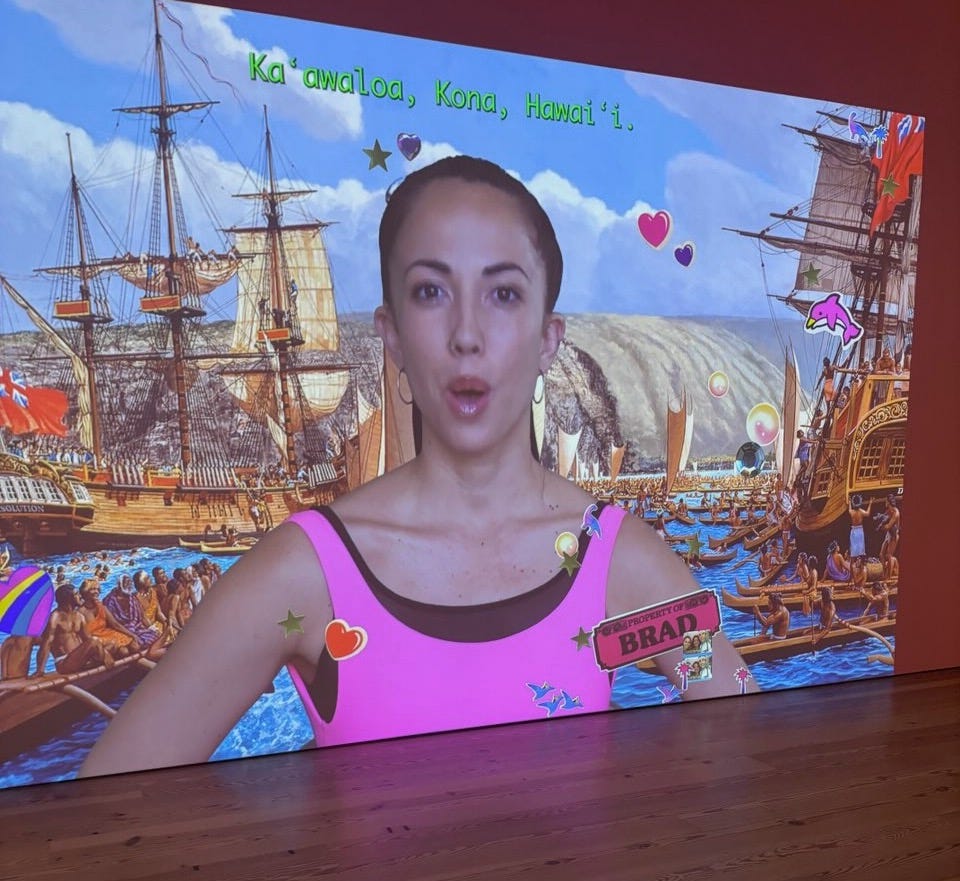
Installation view, kekahi wahi (Drew K. Broderick and Santiago Miata Shiba Nash). Whitney Biennial 2026, Whitney Museum of American Art, New York. The collective layers contemporary digital aesthetics, drone footage, influencer visual language, 90s sticker culture, over the colonial history of Hawaiʻi, exposing how the same landscape continues to be packaged for outside consumption.
The video adopts the visual language of reality television and influencer culture. Drone footage drifts across the shoreline before cutting to carefully staged scenes of exercise routines performed by sculpted bodies along the beach. The imagery feels immediately familiar to anyone accustomed to scrolling through lifestyle content online. Sunlit landscapes, disciplined bodies, and aspirational wellness imagery merge into a visual style that has become ubiquitous across digital media.
What the artists reveal, however, is how easily that aesthetic reproduces older colonial narratives. Hawai‘i has long been framed through tourism and popular media as a paradise designed for leisure and personal renewal. Influencer culture extends that fantasy into the present, presenting the islands as a backdrop for lifestyle performance rather than a place shaped by layered political and historical realities. By replicating the visual language of those platforms so precisely, the video exposes how contemporary media continues to package landscapes as consumable spectacle.
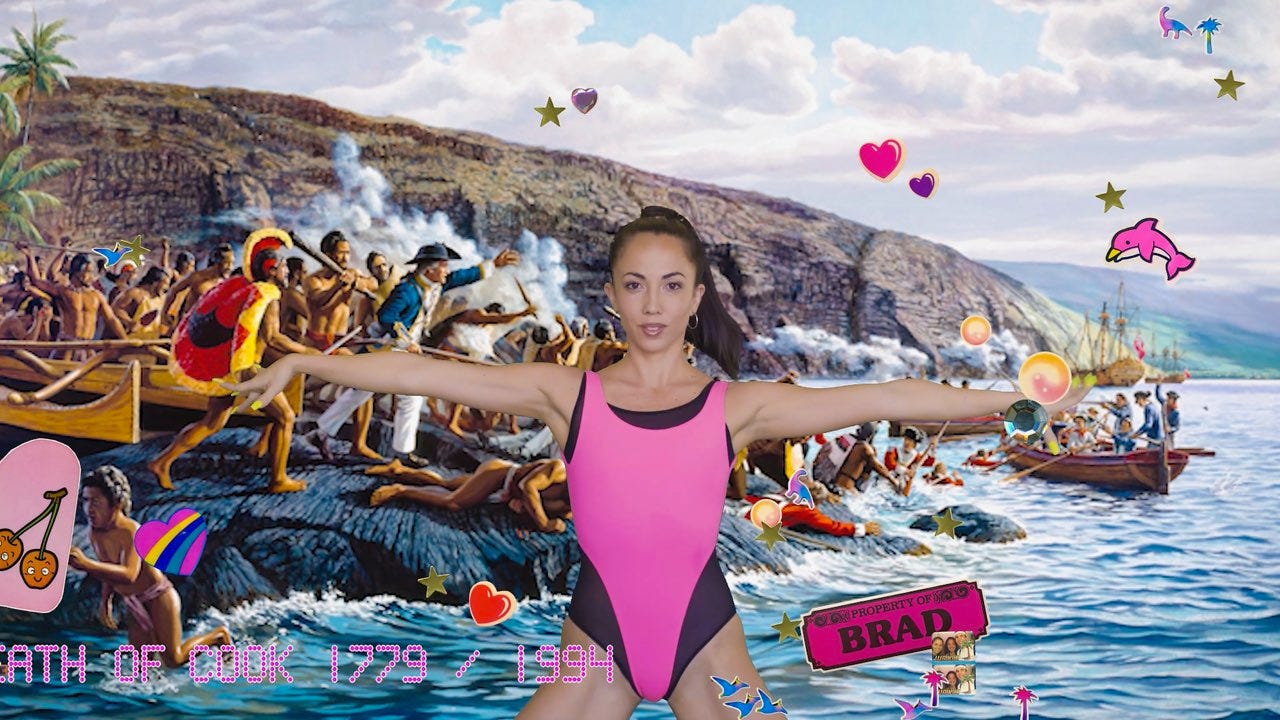
kekahi wahi (Sancia Miala Shiba Nash and Drew K. Broderick) and Bradley Capello, 20-minute workout (still), 2023. Digital video, sound, color; 23:00 min. Released by Aupuni Space, starring Maddie Biven, Josh Tengan, Lise Michelle Suguitan Childers, Reise Kochi, Sean Connelly and YOU
The longer the piece unfolds, the more choreographed the imagery begins to feel. The beach gradually reads less as a natural environment than as a stage on which bodies perform for an invisible audience. What initially appears as lifestyle content slowly reveals itself as a constructed performance embedded within a landscape that has long been subjected to outside projection and consumption.
Another work that introduces a different historical register into the exhibition appears through the inclusion of Filipino composer José Maceda’s Ugnayan. The fifty-one-minute composition was originally broadcast across twenty radio stations in Manila in 1974 as a collective listening experiment. Maceda imagined radio as a medium capable of synchronizing audiences across an entire city, creating a shared experience through sound.
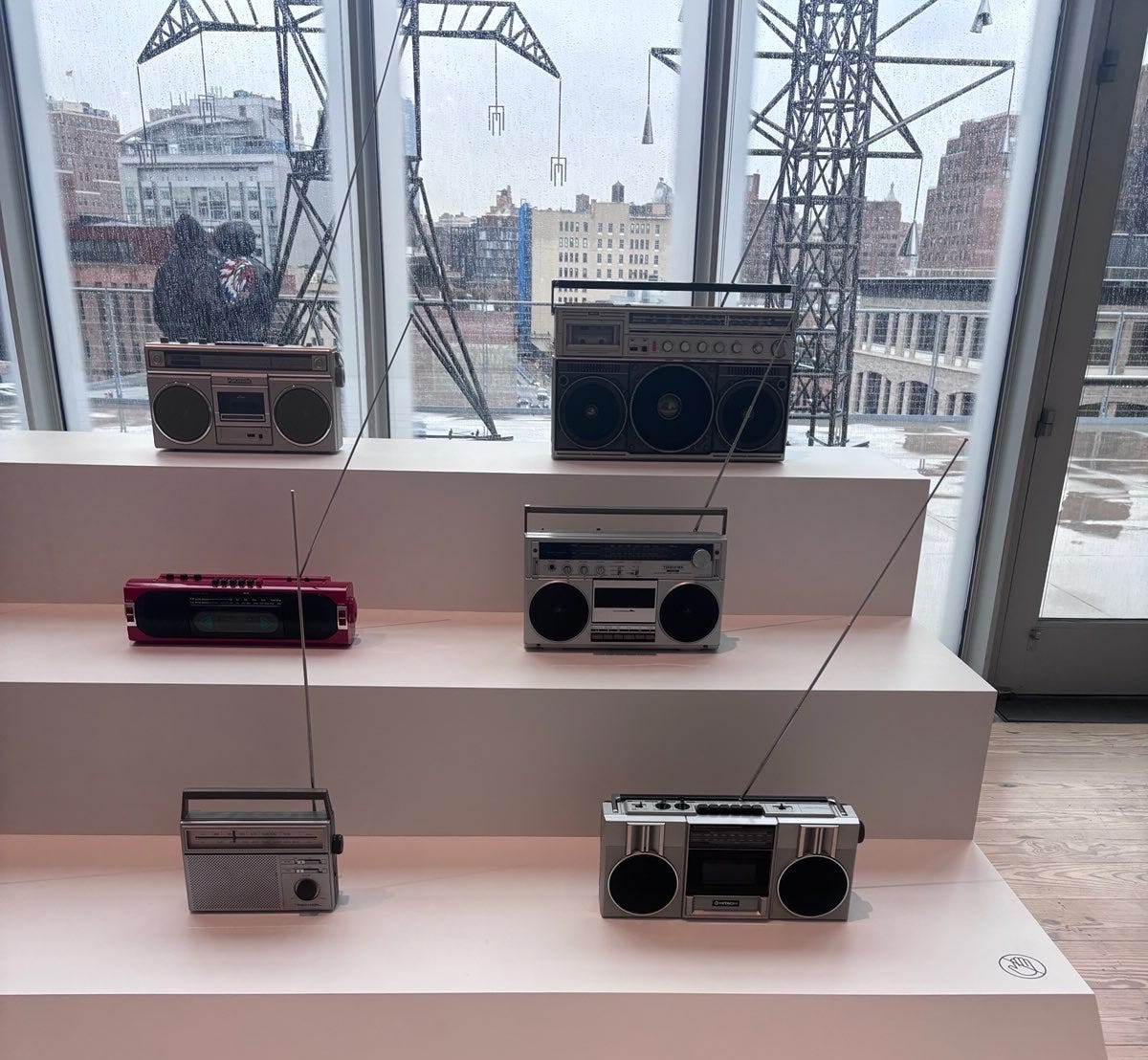
At the Whitney the piece appears as an installation of radios arranged throughout the gallery space. Their transmissions overlap and drift through the room, producing a layered soundscape that visitors move through as they navigate the exhibition. The work carries the feeling of a historical echo from a period when artists were actively imagining mass media as a vehicle for collective participation.
Placed within the context of the biennial, the installation highlights a subtle contrast between earlier artistic ambitions and the contemporary institutional climate. Maceda’s project imagined cultural production as something capable of generating shared public experience. The broader structure of the exhibition surrounding it, by comparison, often feels far more contained.
Taken together these works illuminate the central tension running through the 2026 Whitney Biennial. Many of the artists included in the exhibition clearly engage with complex political realities. Yet the curatorial framework that organizes their work rarely allows those tensions to fully surface. Instead the exhibition distributes them across a conceptual landscape that avoids committing to any single position.
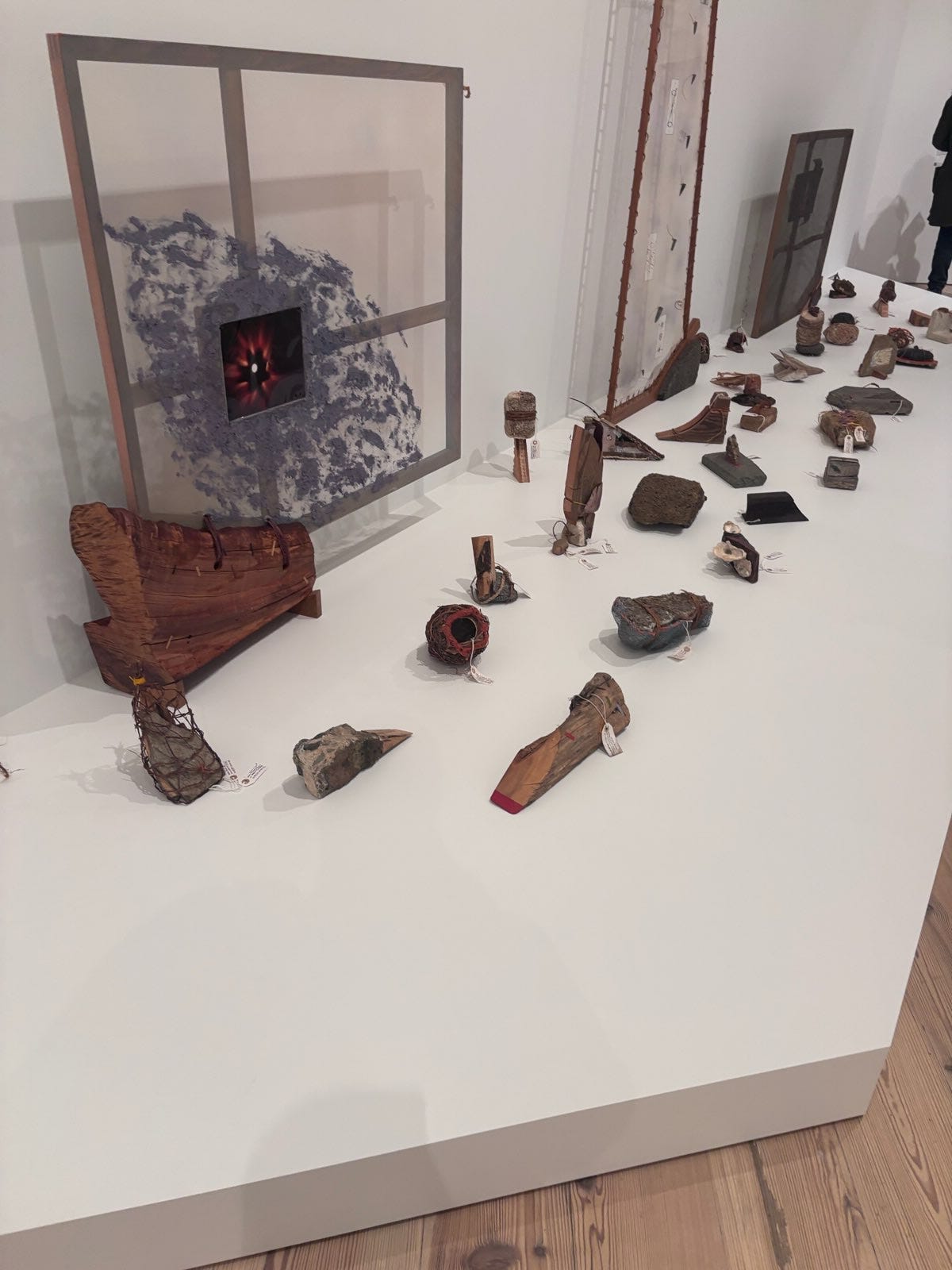
Installation view, Kainoa Gruspe, early fire, when god landed—”before had england, before even had Jesus,” 2025. Whitney Biennial 2026, Whitney Museum of American Art, New York. Gruspe uses materials extracted from the Hawaiian landscape,plants, rocks, wood, reconfiguring them as doorstops on a low platform alongside transparent paintings. The work sits in quiet conversation with the colonial histories running through the floor.
The result is a biennial that feels less like a statement than a balancing act. It acknowledges the presence of the political moment while carefully sidestepping the sharper edges of confrontation. For an exhibition historically associated with measuring the pulse of American art, that reluctance ultimately becomes the most revealing aspect of the show. The Whitney Biennial this year captures a cultural environment in which institutions remain acutely aware of political conflict but increasingly hesitant to stand directly inside it.
Anni Irish is a New York-based arts journalist whose work appears in The Art Newspaper, one of the most widely read publications covering the international art world. She covers institutional culture, labor, and the forces shaping how art is made, shown, and contested in America today. Her writing asks hard questions about the structures the art world tends to protect and does so with the kind of rigor that comes from being deeply embedded in the field. We’re glad to have her voice at the table.
The New Art World is Lion & Lamb’s editorial program, released Fridays, examining the forces shaping contemporary art, its institutions, and the market around it. Anni Irish is our first contributing writer.
This Monday on The Studio Table: what happens when a serious artist enters into genuine dialogue with a system that contains the collective deposit of human visual culture?
The work referenced in that argument is available now exclusively to Salon members before any wider release.
Alexis Mata — Available through Lion & Lamb →
Not yet in the Salon? Work, writing, and invitations not shared publicly join here.