
During the first two hours of Scottsdale Art Week’s opening night reception, a painting by Justin Bua sold through MRG Fine Art for $1,000,000. Indigenous figures in a landscape. Trees, water, a ship in the background. The fair posted the sale itself.
A million dollars. Second-year fair. Two hours in.
That number has context. Art fair sales now account for 35% of dealer turnover, their highest share since 2022. Cross-border friction has pushed collectors toward home markets. But “local” in the UBS data doesn’t mean geographically adjacent. It means familiar. Trusted. Relational. Collectors aren’t buying closer to where they live; they’re buying closer to what they already know how to want. The room is mattering again, and the question isn’t which city you’re in. It’s whether the work in front of you has a legible relationship to something the collector already feels entitled to understand. I walked into Scottsdale’s VIP preview with that as my question: what here actually holds up as specific to this place, and what is simply familiar in a different costume?
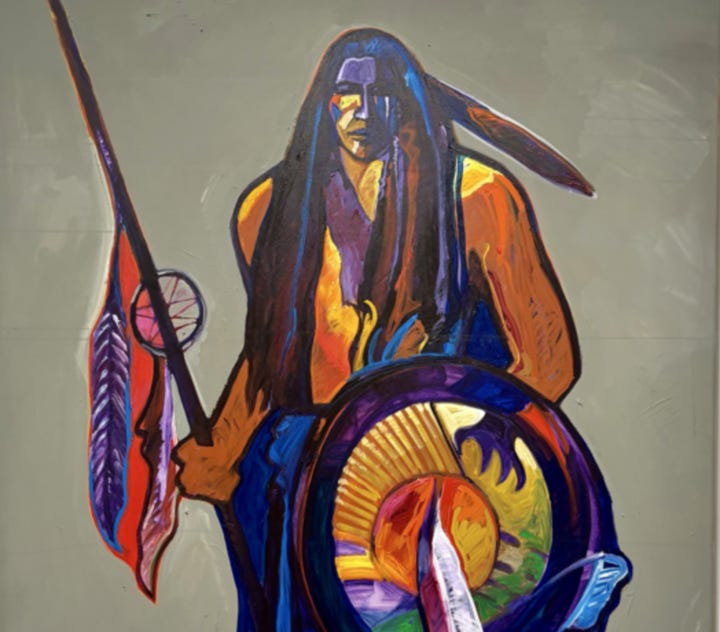
John Nieto American, (1936-2018), “Mystic Warrior,” 1984, acrylic on canvas, signed lower left, signed again, dated and titled on the fold over edge verso. height 60in, width 48in
Scottsdale Art Week positions itself as America’s first fair centered on indigenous expression, work by any maker with a genuine connection to place. Arizona holds the third-largest Native American population in the United States. The material exists to support the claim. The question is whether the floor delivered.
Among the first works I encountered: Miró prints. Chagall. A wall of Picasso lithographs in matching gold frames. Programs from Baltimore, New York, Korea. This is what every regional fair with international ambitions looks like in year two. Identity at a fair isn’t declared; it’s accumulated through what returns, what sells, and what collectors decide is worth finding. To read that, you stop looking at the walls and start looking at the sales.
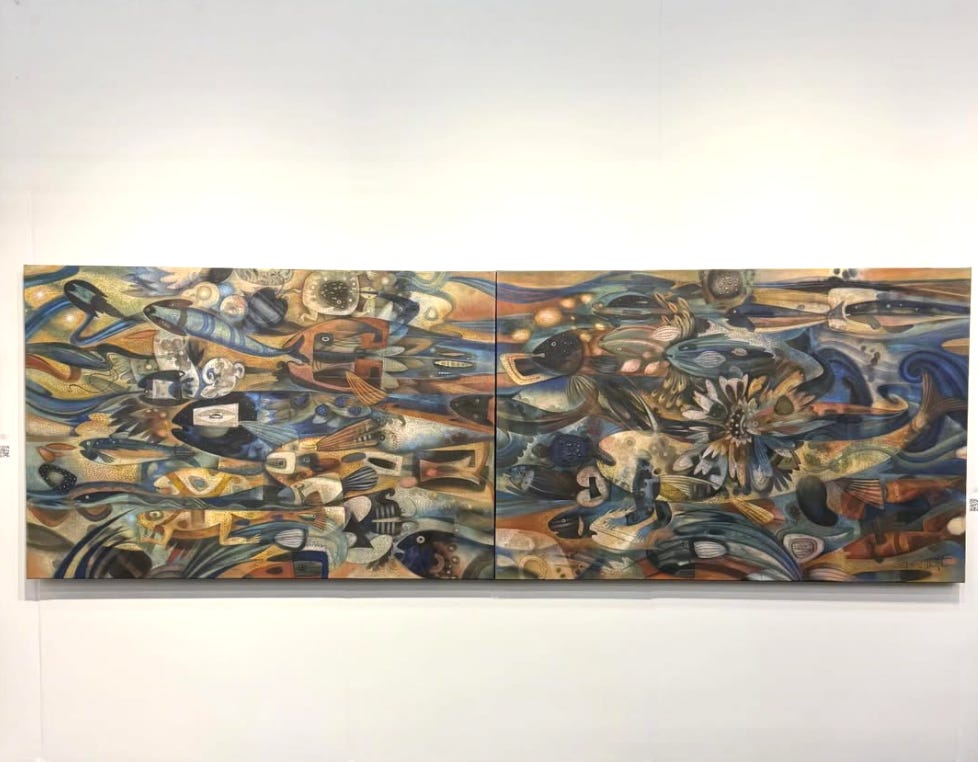
Tony Abeyta (Dine) The River, 2024-2026 Oil on canvas 140 x 50 inches (diptych)
The largest confirmed sale I documented was $80,000, to Tony Abeyta for The River, a 50-by-140-inch diptych at Earth Maker Gallery. Abeyta is Navajo. His work draws directly from the landscape and traditions of the Southwest. At the same booth: Thomas “Breeze” Marcus, a Tohono O’odham artist whose line work draws on basket-weaving traditions; Gloria Martinez-Granados, who cross-stitched on produce bags and called it labor history; Douglas Miles working in vintage suitcase assemblage. A program making a serious curatorial argument for what regional expression looks like when taken seriously as contemporary practice. It sold.
Ed Mell died in 2024 after spending his career rendering Arizona in geometric abstraction. His Canyon Wall sold opening night for $10,800. John Nieto’s Mystic Warrior, painted in 1984, sold for $55,000. These aren’t artists finding their market. Their relationship to this place is already historical record. That they moved in the first hours tells you exactly what this collector came to find.
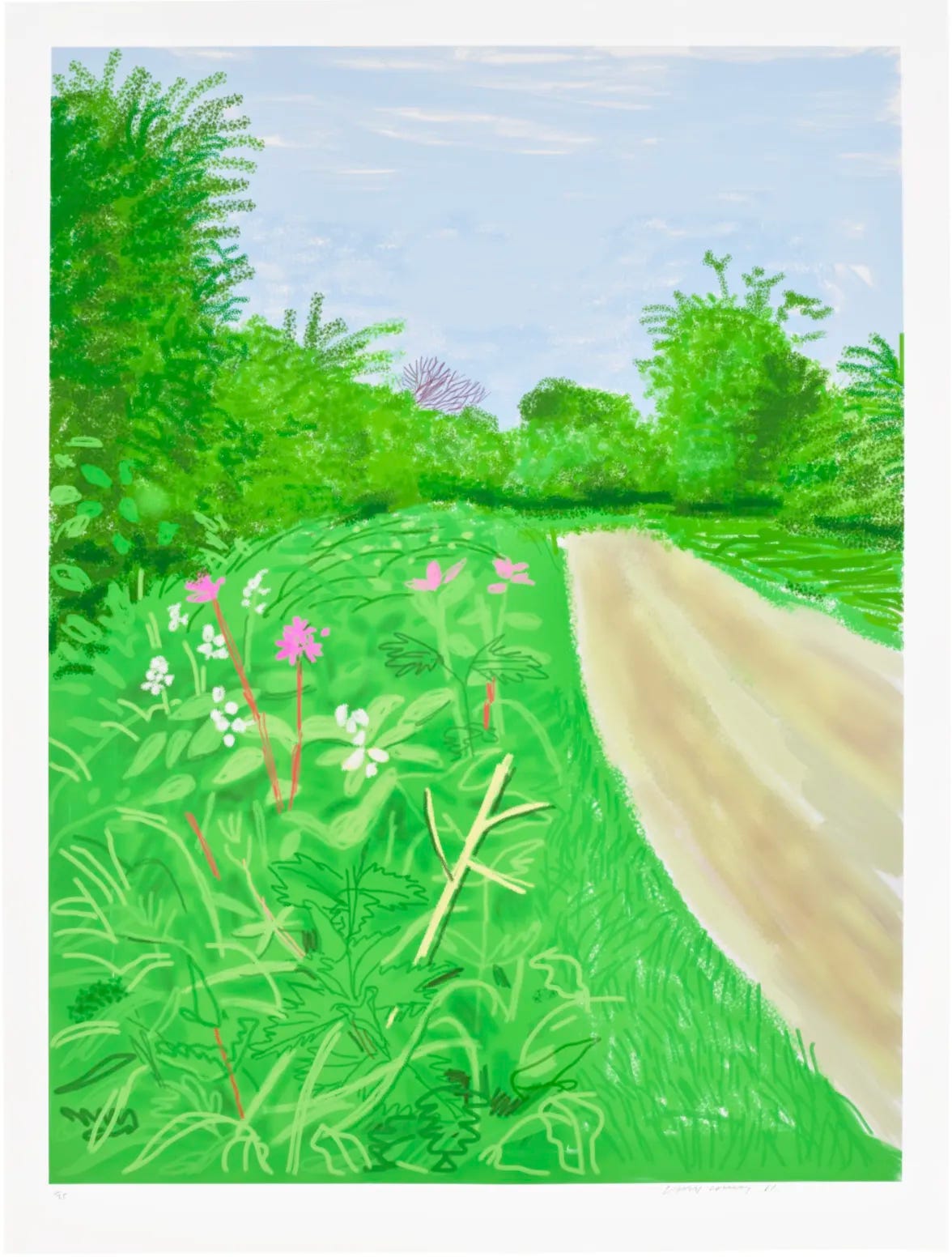
David Hockney BRITISH, b. 1937 The Arrival of Spring in Woldgate, East Yorkshire in 2011. 26 April, 2011
iPad drawing on paper 140 x 105cm 55.1 x 41.3 inches Edition of 25 – Blond Contemporary Gallery
A David Hockney iPad drawing was also present. Work that could travel anywhere was on the floor and visible. Some of it moved. But the strongest early sales, consistently, without exception, were tied to work with a documentable relationship to place. Not as curatorial statement. As market outcome.
Not everything on the floor was contemporary. Antique textile and ceremonial work appeared across several booths, testing how far the fair’s “connection to place” claim could stretch.
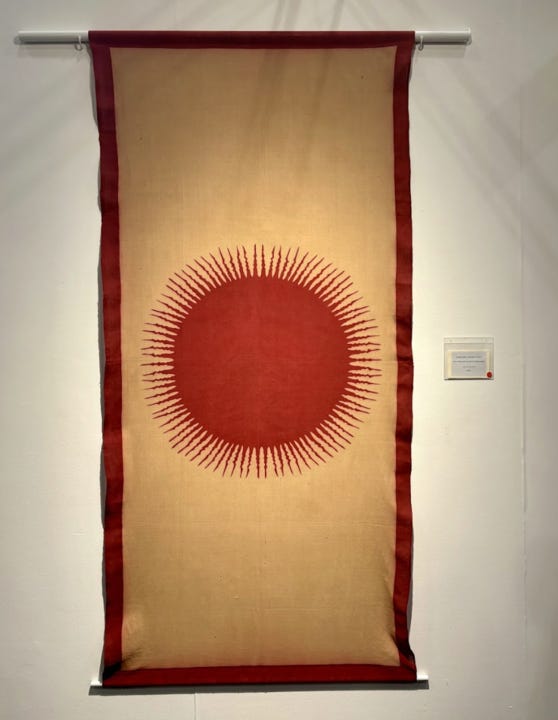
18th or 19th-century Indian Mata Hari (’eye of the day’) ceremonial cloth
For artists, the implication is sharper than it first appears. Presence at a fair is no longer the differentiator; what you bring is. A booth at Scottsdale with work that could show in Aspen or Miami is a different proposition than a booth with work that could only make sense here. The collector this fair, and arguably all regional fairs, is producing, isn’t browsing for quality. They’re looking for something they can’t find anywhere else, and they’re getting better at knowing the difference. The canon of what belongs in this room is still being written. Year two is when that argument is open. Year ten, it’s settled.
For collectors, the “local is relational” shift has a practical consequence that isn’t comfortable: the work that carries genuine community and place specificity is now the most aggressively sought. It’s not the easiest to find on the floor; it doesn’t always have the biggest booth or the most recognizable name, but it’s the first to go. Twenty-three percent of total sales in the inaugural edition happened within the first three hours of preview. That number isn’t about urgency for its own sake. It’s about a specific type of collector who did the work before they walked in, knew what they were looking for, and moved when they found it.
That preparation isn’t accidental. It comes from relationships built before the fair opens, with dealers, with artists, with people who know which booth matters and why. The collector who discovers work with deep ties to this place on the floor is already late. The ones who got there first weren’t browsing. They were arriving. This is consistent with how serious collecting has always worked, but the stakes of that relational infrastructure are compressing. The hunt increasingly happens before the doors open. Who you know, and what those people tell you, is becoming the differentiator, not how long you spend on the floor or who got you into VIP night.
What makes Scottsdale worth paying attention to beyond its own sales data is what it could authorize. A fair establishing identity in a market this young, surrounded by significant capital and a collector base still developing its eye, has unusual leverage. The precedent it sets for what belongs in this room doesn’t stay in this room. Tribal and indigenous work has historically been categorized as artifact before art, priced accordingly, and placed outside the contemporary conversation. A fair in year two that puts Tony Abeyta at $80,000 next to a Hockney, and lets the Abeyta win the opening night narrative, is doing something with consequences beyond Scottsdale. Mexican indigenous work, chronically undervalued relative to its historical and cultural weight, is the obvious next argument this fair is positioned to make. It hasn’t made it yet. But the infrastructure for that argument is being built right now, in a place with the money to receive it and the identity pressure to need it. The geography alone makes the argument: Scottsdale sits at the cultural crossroads of the American Southwest and Mexico, and the market hasn’t priced that in yet. The window for that argument is open. It won’t stay that way.
I walked in asking what holds up and what could exist anywhere. By the end of the evening, the answer was direct: the work that knows where it comes from competed at the very top. Everything else could travel.
But the more consequential question isn’t what sold on opening night. Scottsdale is also doing something larger: a young fair in a capital-rich, taste-poor market is writing the first draft of what indigenous and regional work is worth, and that precedent will outlast the fair itself. The window for this argument has been open a long time. Scottsdale may be the room where it finally gets made.
Kate Prinzo is a dealer and market analyst at Lion & Lamb, a platform working at the intersection of art, culture, and long-term positioning.
Thank you for reading!